
One of the biggest debates in the functional mushroom space currently, is whether products made with the fruiting body (the visible cap and stem) or with the mycelium are superior in terms of potency and effect.

I spent several years as a researcher and instructor at HafenCity University while I was living in Hamburg, Germany. Though my research focused mostly on sustainability and water, I also gained valuable insight into the importance of looking into who is doing the research, and to what aim. This lesson is particularly relevant in the mushroom industry, where passion often intersects with profit.
For example, one of the biggest proponents of mycelium-on-grain (MOG) products is Paul Stamets, perhaps the most well-known mycologist on Earth. His brand, Host Defense, uses solely MOG products, and his research team consistently finds that mycelium and fermented grain substrate act together to be more beneficial than just using the fruiting body of the mushroom. Whether true or not, supporting your brand with your own research is a pretty obvious conflict of interest even if it is good research. (On a side note, we’re fans of his work and appreciate the attention he’s brought to mycology through his books and public speaking.)
On the other side of the ring is another well-known mycologist, Jeff Chilton, the owner of Nammex and another pioneer in mycological research. He believes heavily in fruiting body-only supplements, arguing that MOG products are often primarily starch, not mushroom. His business model depends on people moving away from myceliated products.
These two leading figures in mycology are at loggerheads. So what does the peer-reviewed, independently funded research say?
The Fruiting Body Argument: The Power of Polysaccharides
Much of the traditional use and scientific research on medicinal mushrooms has focused on the fruiting body. The primary active compounds highlighted here are beta-glucans, complex polysaccharides known for their immune-modulating properties.
Independent analysis, often using methods championed by Jeff Chilton, frequently finds that fruiting body extracts contain significantly higher concentrations of beta-glucans compared to mycelium grown on grain. The argument here is that mycelium-on-grain products contain a large percentage of the grain substrate itself (often rice or oats), which is primarily starch (alpha-glucans), rather than the potent mushroom compounds. If you’re buying a mushroom product for immune support, higher beta-glucan content is generally seen as superior. Triterpenes, another class of beneficial compounds found in mushrooms like Reishi, are also typically more concentrated in the fruiting body.
The Mycelium Argument: Unique Compounds and Neuroprotection
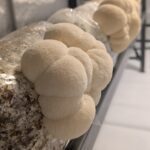
While fruiting bodies excel in general immune support, the mycelium side of the debate gains significant ground when discussing specific, unique compounds that may be more prevalent or even exclusive to the mycelial network. The prime example here is Lion’s Mane (Hericium erinaceus).
Research has shown that the mycelium of Lion’s Mane contains compounds called erinacines, which are potent stimulators of Nerve Growth Factor (NGF). NGF plays a crucial role in the growth, maintenance, and survival of neurons. These erinacines are found almost exclusively in the mycelium, not the fruiting body.
A recent 2024 randomized, double-blind, placebo-controlled pilot study (Černelič Bizjak et al., “Effect of erinacine A-enriched Hericium erinaceus supplementation on cognition”) found that subjects taking an erinacine A-enriched Lion’s Mane mycelium supplement showed significant improvements in cognitive function scores over an 8-week period. This is a robust piece of evidence for the cognitive benefits of mycelium, particularly for Lion’s Mane. The study highlights that mycelium contains unique compounds that the fruiting body lacks, making it essential for certain applications.
Furthermore, proponents of mycelium-on-grain argue that the grain substrate itself isn’t just “filler.” As the mycelium colonizes the grain, it ferments and transforms the substrate, potentially creating new bioactive compounds or making existing ones more bioavailable. This “myceliated grain” is seen by some as a distinct and valuable product. Something similar to tempeh or tofu, made from fermented soybeans which has been shown to be a powerful probiotic.
The Verdict: It’s Not So Black and White
So, who’s right? The independent, peer-reviewed research suggests that both sides have valid points, and the answer depends heavily on the specific mushroom and the desired health benefit.
- For broad immune support (especially high beta-glucans and triterpenes): The fruiting body generally holds the advantage, with higher concentrations of these well-researched compounds and a long history of traditional use.
- For specific neurocognitive benefits (especially with Lion’s Mane): Mycelium becomes critically important due to its unique erinacine content. If your goal is to support NGF and cognitive function, an erinacine-enriched mycelial product is likely your best bet.
Understanding the strengths of both the fruiting body and the mycelium allows you to make an educated choice, ensuring you’re getting the active compounds you’re actually paying for. That’s why we are following the science, and will continue to adapt our products to be as beneficial as possible.
Sources:
1. fungi.com (Paul Stamets website)
2. nammex.com (Jefff Chilton website)
3. Benson, K. F., Stamets, P., Davis, R., Nierengarten, R., Ma, R., & Wellness, R. (2019). The mycelium of the Trametes versicolor (Turkey tail) mushroom and its fermented substrate each show potent and complementary immune activating properties in vitro. BMC Complementary and Alternative Medicine, 19(1), 342. https://doi.org/10.1186/s12906-019-2681-7
4. Černelič Bizjak, M., Jenko Pražnikar, Z., Kenig, S., Šprah, L., & Petelin, A. (2024). Effect of erinacine A-enriched Hericium erinaceus supplementation on cognition: A randomized, double-blind, placebo-controlled pilot study. Journal of Functional Foods, 115, 106120. https://doi.org/10.1016/j.jff.2024.106120
5. Li, I. C., Chang, H. H., Lin, C. H., Chen, W. P., Lu, T. H., Lee, L. Y., Chen, Y. W., Chen, Y. P., Chen, C. C., & Lin, D. P. (2020). Prevention of early Alzheimer’s disease by erinacine A-enriched Hericium erinaceus mycelia pilot double-blind placebo-controlled study. Frontiers in Aging Neuroscience, 12, 155. https://doi.org/10.3389/fnagi.2020.00155